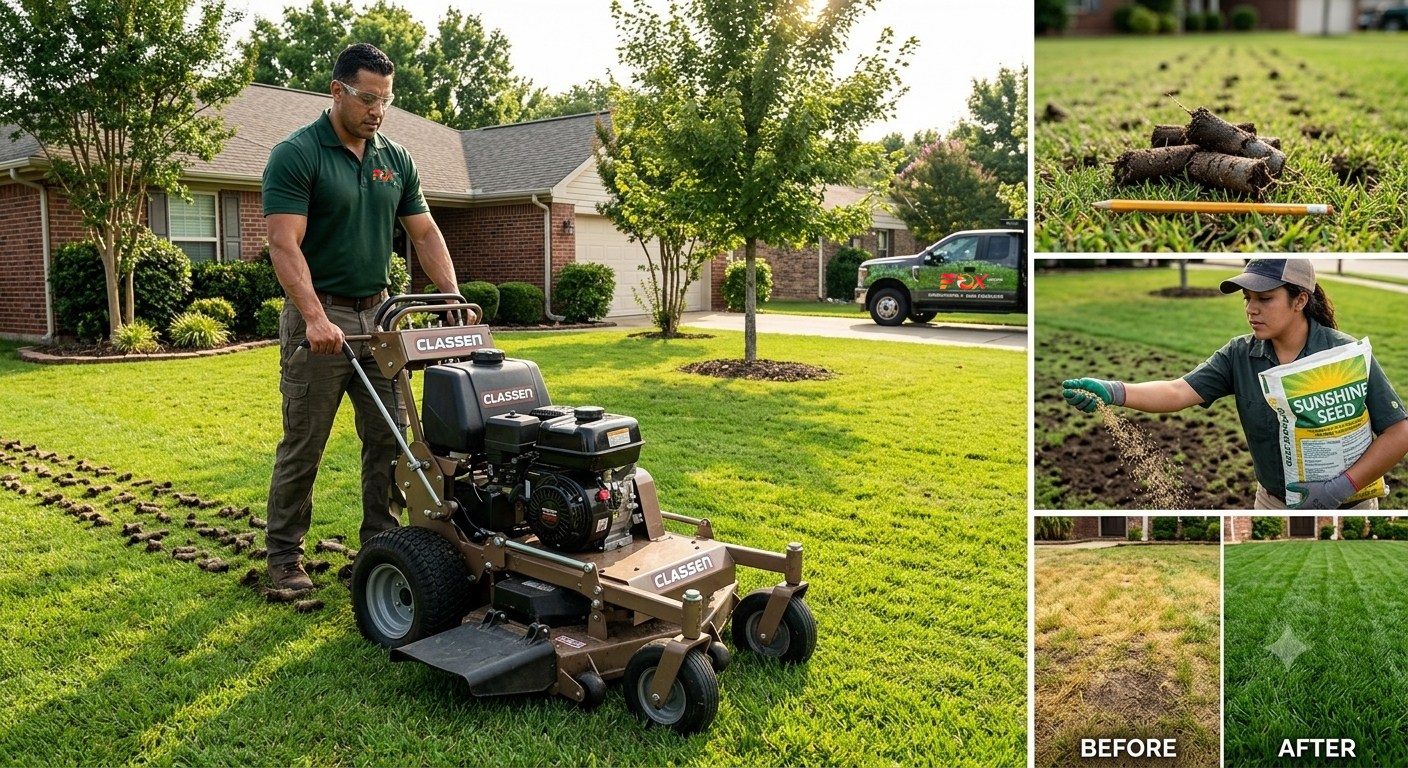
If you want a lush, thick, vibrant green lawn next spring, the secret doesn’t start in April—it starts right now.
While most homeowners associate lawn care with spring preparation, local turf experts in Montgomery County know that late August through September is the prime window for core lawn aeration and overseeding.
If your lawn has endured the scorching heat of summer, heavy foot traffic, or continuous compaction from heavy soil, here is why scheduling your core aeration now will yield the absolute best results for your turf.
The Heavy Problem: Clay Soil Compaction in PA
In Montgomery County and throughout southeastern Pennsylvania, lawns face a common enemy: heavy clay soil.
Clay soils are densely packed by nature. Throughout late spring and summer, regular foot traffic, lawnmowers, and intense heat baked that soil into a brick-like layer. Compaction prevents your lawn from breathing, starving root systems of three essential elements:
- Air (oxygen required for root respiration)
- Water (rainfall runs right off instead of soaking in)
- Nutrients (fertilizer stays trapped on the surface)
When grass roots can’t penetrate deep into the ground, they stay shallow and weak, making your turf extremely vulnerable to summer drought, disease, and weed invasion.
Core Aeration vs. Spike Aeration: What’s the Difference?
When shopping for aeration services, it’s crucial to understand that not all aeration techniques are created equal.
CORE vs. SPIKE AERATION
| CORE AERATION (The Professional Way) | SPIKE AERATION (The Temporary Fix) |
| Pulls physical 2-3 inch soil plugs out of the earth | Pokes solid spikes into the dirt |
| Relieves compaction instantly & leaves space for roots | Pushes soil outward, increasing compaction surrounding holes |
| Opens direct channels for seed, water, and fertilizer | Holes close quickly without long-term benefits |
- Core Aeration: Uses a specialized machine equipped with hollow tines to physically pull $2\text{–}3\text{ inch}$ soil plugs (cores) out of the ground. This instantly relieves soil pressure, breaks up thatch, and opens direct pathways to the root zone.
- Spike Aeration: Simply pokes holes into the ground with solid spikes. Instead of relieving compaction, it actually pushes the surrounding dirt sideways, increasing compaction around the hole.
At Fox Landscaping, we exclusively perform hollow-tine core aeration to give your soil true relief.
Why Late August to September is the Sweet Spot
Timing is everything when it comes to turf restoration. Late summer and early fall create the absolute perfect environmental “storm” for core aeration and overseeding in Pennsylvania:
1. Soil is Warm, but Air is Cooling
Cool-season grass seeds like Turf-Type Tall Fescue, Kentucky Bluegrass, and Perennial Ryegrass germinate best when soil temperatures are warm ($55^\circ\text{F}$ to $70^\circ\text{F}$) and air temperatures are comfortable. August and September offer ideal conditions for fast seed germination without the scorching heat that kills young seedlings.
2. Fewer Weeds to Fight
In spring, aggressive weeds like crabgrass, dandelions, and clover are actively germinating and competing for nutrients. By late summer, annual weeds stop germinating, giving your fresh grass seed zero competition while it establishes.
3. Maximum Root Development Before Winter
Seeding in late summer allows grass roots several months to grow deep into the soil before winter dormancy sets in. When spring arrives, your lawn already has a mature, established root system ready to burst into thick growth.
Pairing Aeration with Overseeding for Spring Results
Core aeration opens up thousands of tiny holes across your lawn—creating the absolute ultimate seedbed.
When you overseed immediately after core aeration, the seeds fall directly into the core holes. This provides:
- Optimal Seed-to-Soil Contact: Seed that sits on hard soil dries out and dies. Seed tucked safely inside an aeration hole stays protected, moist, and securely rooted.
- Thicker Lawn Density: Filling in thin patches now leaves no room for crabgrass or winter weeds to take over in early spring.
Post-Seeding Care: How to Water for Success
Once your lawn is aerated and overseeded, watering properly is the most important step in protecting your investment.
- Days 1 to 14 (Germination Phase): Water lightly 2–3 times a day for short periods (10–15 minutes per zone). The goal is to keep the top inch of soil consistently moist, never dry, and never flooded.
- Weeks 3 to 4 (Establishment Phase): Once you see green sprouts, transition to deeper, less frequent watering (30–45 minutes, 2–3 times a week) to encourage roots to stretch deep into the newly aerated soil.
Schedule Your Lawn Aeration in Montgomery County Today!
Our late August and September aeration schedules fill up fast every season. Don’t wait until the winter frost settles in or risk playing catch-up next spring!
Whether you need core aeration in PA, professional overseeding, or a complete fall lawn renovation, Fox Landscaping is ready to deliver the thickest, healthiest lawn on the block.